Here
is my first experiment with new materials incorporated with my
photograms. I've uploaded a process photo, since this methodology
involves several stages of development.
Fist, I
experimented with the ground on which I would do the photogram. I found
this awesome gesso at Michael's that, although a bit pricey, has the
awesome effect of shrinking as it dries and thereby distorting the
canvas and cracking. Since this semester I am focusing on the erosion
of the body and false identities, this seemed like the perfect material
to experiment with.
Secondly, I began a painting with
no particular image in mind. Mostly, I wanted to choose colors and
strokes that were tuned directly into how I felt. I began with warm
colors and smooth gradients in the top right, but as my OCD sank in and I
began obsessing over details, the motion became broken and circular
with a colder and darker palette, which created an image very similar to
the perpetual storm on Jupiter's surface. I was not satisfied with the
piece with just paint, however, and I felt like the darker area needed
something else, something that reflected the weight and pressure of the
manic desire for perfection. So, I went outside and started pulling up
grass and weeds, covered the canvas with glue, and threw it on and
painted it in. This enhanced the feeling of mania and hysteria for me,
and connected a medium which I was in complete control with materials
directly from nature that I attempted to force into my creative logic.
Lastly,
I incorporate my body directly into the image with the photogram. In
the case, the emulsion literally becomes a mask, covering the color of
the paint in black but unable to completely adhere to its underlying
surface, much like my previous piece Touched.
I'm not entirely sure how I feel about this
piece, but I know that it needed to be created and that my future works
will in some way be influenced by what I learned here, and that may be
the most important thing. I've learned more through my failures in the
past year than I have in my successes, and though the lack of concrete
"progress" in my mind can be infuriating, it is nevertheless necessary.
Showing posts with label silhouette. Show all posts
Wednesday, February 13, 2013
Wednesday, December 19, 2012
MFA Show Walkthrough
2012 MFA Fall Show walkthrough from gunslingers19 on Vimeo.
Texas A&M's Master of Fine Arts in Visualization has their 2012 Fall show in Langford C's Studio A.
For those of you who like to see art in a more live setting, I did a video walkthrough of the show. The video cam out a little fuzzy, so I apologize.
Texas A&M's Master of Fine Arts in Visualization has their 2012 Fall show in Langford C's Studio A.
For those of you who like to see art in a more live setting, I did a video walkthrough of the show. The video cam out a little fuzzy, so I apologize.
Labels:
3D,
art,
digital,
gallery,
illustration,
interactive,
mfa,
painting,
photogram,
photography,
sculpture,
silhouette,
space,
tamu,
texas A and M,
video,
visualization
Highlights from my work in the 2012 MFA Show
Imprints
My work demonstrates
intimate realities that flow behind the façades I project into the world. In conceptualizing these images I call
upon the emotional undercurrents that clash with the carnal self; a self that
enables one identity to conceal another.
Using a photographic emulsion and artificial light, I capture in silhouette
the presence of my physical body.
The processes and surfaces resist my control; the resulting abstraction
of the literal form articulate the otherwise concealed emotional and
psychological structures. The
frustration of my inability to fully determine the outcome appear in the image
as flaws, tears, fingerprints, and inadvertent patterns that communicate the
dissonance between internal dialogue and outward appearance, revealing without
my permission that which I had longed to hide
-R.J. Peña
Labels:
alternative,
art,
black and white,
cloth,
darkroom,
figure,
gay,
grunge,
homosexual,
mfa,
nude,
nudogram,
photogram,
photography,
silhouette,
tamu,
texas A and M
Monday, November 05, 2012
Touched
So now I've gotten comfortable enough working with the emulsion that I've begun to do more large scale works, even though using so much of the emulsion at one time kind of makes me cringe! The last piece I completed, which I will post about later even though it did not turn out anything like I had planned or expected, had revealed an entirely new direction in which to take my art.
In this piece, titled Touched, I draw upon one of my most vivid and powerful memories: the events leading up to my first kiss. At this point in my life, I was struggling greatly with the knowledge of my sexuality and the fear of the consequences from my family. My father vehemently forbade any expression of being gay,and forced me to go to therapy in order to correct the mental illness I was suffering from. However, myself, being as strong-willed and bullheaded as he, knew that this was not going to change. I had known my orientation from the age of 10, and had spent the previous 5 years concealing it and dealing with the emotional consequences on my own. But this suppression had a backlash, creating an obsessive desire to find someone, to touch, to express these terrible desires that were forbidden, and yet pulling at my core as potently as the need to survive. I finally found someone who was capable of returning my affections when I was 15, and you cannot imagine the excitement, the relief of knowing I was not alone, that overwhelmed my senses. Yet even still, I was terrified of my father and of what could erupt upon the discovery of this treasure. And then that summer, at a friend's birthday party in Galveston, I found myself outside with him out on the patio overlooking the ocean with a strong warm breeze washing over us and the sounds of the crashing waves drowning out everything but us in this electric moment. The year had already been difficult, with me coming out to my parents and dealing with depression and isolation and the constant threats from my father to both of us. So at first we were just talking, each safe in our own sleeping bags, but the longer we looked into each others eyes the more irresistible the pull became, until suddenly we were holding each others arms. Each of us were so desperate to touch one another and share this simple contact and yet so horrified at the thought. Him with the backlash of religion and me from the strong boot of my dad pressing on me. The strain of energy coursing across my nervous system was so great I felt as if I could burst at any moment.
And then he kissed me.
There has not been another moment in my life when the touch of another has filled me with so much thrill, so much wanting and need, than in that moment. Every single detail of that moment and the unimaginable bliss that someone could want me as badly as I wanted them for the first time in the five years I had suffered alone has never faded from my memory, and it is due to such things that I now feel the confidence in myself to express in my art.
Here was my process:
I laid a foundation of an oil based primer with my hands upon cloth, using my body to throw and spread the paint, leaving traces of my palms and fingers across the material. I then used a paint roller to cover this with emulsion, almost erasing the traces with the medium I would then use to capture my body and that of Gavin, in the position that mimicked my memory. Because the emulsion was a bit tacky, and because it could not bond properly with the oil primer, the contact with our bodies loosened it and caused it to tear where it contacted our skin, and later while processing, giant holes appeared. The image has become a mirror of the emotional turbulence I felt: a suppressed desire to touch, covered with a superficial appearance that was slowly degrading under the power of this basic need.
Labels:
art,
black and white,
canvas,
darkroom,
desire,
emulsion,
gay,
GLBT,
homosexual,
nudogram,
photogram,
photography,
silhouette,
simulacra,
touch,
youth
Thursday, October 18, 2012
1st Pieces for "Beyond the Screen"


I did it! I got the wonderful Jace Kerby to model for me, and composed my first human shadow captures in my darkroom. The piece on the left is titled "Is Someone There?" and the piece on the right is "I See You," and I feel as if the pieces compliment each other. The original images are the ones with the white silhouettes, of course, since I haven't mastered the process of turning the negatives into positives in the processing, so I'm going to get the digitally inverted images printed at the same size as the original. I know, the aesthetic will not be the same, but it's fascinating when looked at in terms of the simulacra and appropriation. Each step in the process delivers an alternate perspective and challenges the verisimilitude of the images which preceded it, and in this light I am left wondering which presentation is authentic in its representation. The dialogue between my thoughts and the image intensifies the intent of the subject, the emotive response, and the awareness of voyeurism.
What strikes me about these two together is the position in which the viewer is placed in the narrative. In Is Someone There? I feel as if I'm am the voyeur, intruding into the privacy of another who is yet unaware of my presence. There is an apprehension that I will be caught, yet the desire to remove the screen and observe the mysteries beyond entices me. The brush strokes and imperfections reinforce the illusion of a veil between me and the subject which becomes ethereal beneath the weight of my gaze.
In I See You, this position is reversed: now I feel as if I am the victim of the intrusion, threatened by the gaze of an unknown other beyond the veil. I am struck by a desire to rip down the screen so that this unknown may be recognized and I may objectify the foe, therefore reclaiming the gaze that has been forced back upon me. I find myself recoiling, almost ashamed, as if this perpetrator has caught me in some unseemly deed when I believed no one was looking, and I am reminded of the gaze of the Other and the need to hide myself behind the mask of a projected identity.
Labels:
appropriation,
art,
black and white,
darkroom,
gaze,
lacan,
other,
photogram,
photography,
screen,
silhouette,
simulacra,
voyeur
Tuesday, October 16, 2012
Finally Time for Some Art!
This weekend was full of trial and error and retrial and more
error, set on repeat. There were lots of bugs to iron out with the
darkroom, including but not limited to: faulty emulsion adhesion to the
canvas, inconsistent fogging of the images, weird brown aberrations that
appeared a few hours after fixing the emulsion, and the emulsion
softening and becoming gel-like during the washing phase. Here are a
few images related to the errors:
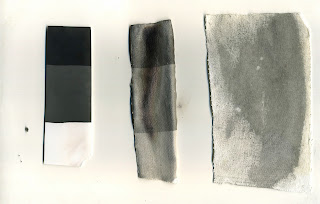
The image on the left shows the first tests I did on a few different
materials. The one in the middle is the artist's canvas I bought from
Hobby Lobby, and the times of exposure on this strip was 3 seconds, 1.5
seconds, and 0 seconds.. One side is primed with some kind of gesso,
probably acrylic. A major issue we had was that the strips curled
tightly upon developing and fixing. I'm guessing this has to do with
the developer affecting the acrylic primer, softening it and causing the
fabric to distort. The portion in the center that turned a weird
black/brown color was where the emulsion was applied too thickly, and I
believe the fixer was not able to penetrate into this area, causing a
slow reaction hours after I brought it out of the darkroom. One of the
first errors I noticed was that the unexposed portion greyed
significantly, which meant I had a fogging issue with one of the
safelights in the darkroom. To test this I got normal photo paper,
turned off the Patterson Safelight on the desk, and exposed with the
same time. This is the test on the left. With the Patterson Safelight
off, I got no fogging.
Thinking the problem was solved, I stretched some rough white fabric that I purchased from Walmart (for a fraction of the price of the canvas from Hobby Lobby!) over a frame and coated it with the emulsion, and then I did two more strip testsjust to be safe. The length of expousre was 1 second per region, up to 15 seconds. The long strip on the left had 1 coat of emulsion, and the strip on the right had 2, just to throw in another variable. The result had both unexpected and expected results: Neither strip curled during processing, which was great news. The strip with 2 coats and a deeper contrast range, which is definitely good to know, however added layer of emulsion softens immensely while washing the fixer off in water, and actually came off while I was patting it dry with a paper towel, which you can see in the middle. One thing I was frustrated to see, is that the unexposed portion STILL managed to get severely fogged. So I decided to do another test: First, I put a paper towel over the opening of the overhead safelight to dilute the light even further. Then, I coated the same Walmart fabric with 1 coat of the emulsion and developed it without exposing. The result is the right piece of fabric in the leftmost image. As you can see, there was a strange inconsistency in the tone of the image. What I realized, is that before I stopped using the Patterson safelight, I had been coating strips on the desk near the light and, thinking myself frugal, was pouring the excess emulsion back into the bottle, and thereby unknowingly contaminated the whole bottle with exposed emulsion :( However, now that I solved this, I could FINALLY move on with creating some art!
Now came the question of what to do with the canvas I had inadvertently painted with fogged emulsion. Since I knew I wasn't going to get the nice bright whites of a pure silhouette, I decided to experiment with some chemogramming, which is mixing the different processing chemicals to achieve specific effects. I grabbed a plastic bag and some more grass and a miniature of a sculpture from a previous project and laid them onto the canvas, and then loaded a paintbrush with the fixative and splattered it onto the canvas. After waiting a few minutes, I exposed the emulsion and developed, and just as I had hoped, the fixative had prevented to fogged emulsion from developing, and I was able to maintain some pure whites in the image.
This is the inverted image of a print I produced last week, which I feel is more effective. Hopefully, using either contact printing or the projector I will be able to achieve this.
Thinking the problem was solved, I stretched some rough white fabric that I purchased from Walmart (for a fraction of the price of the canvas from Hobby Lobby!) over a frame and coated it with the emulsion, and then I did two more strip testsjust to be safe. The length of expousre was 1 second per region, up to 15 seconds. The long strip on the left had 1 coat of emulsion, and the strip on the right had 2, just to throw in another variable. The result had both unexpected and expected results: Neither strip curled during processing, which was great news. The strip with 2 coats and a deeper contrast range, which is definitely good to know, however added layer of emulsion softens immensely while washing the fixer off in water, and actually came off while I was patting it dry with a paper towel, which you can see in the middle. One thing I was frustrated to see, is that the unexposed portion STILL managed to get severely fogged. So I decided to do another test: First, I put a paper towel over the opening of the overhead safelight to dilute the light even further. Then, I coated the same Walmart fabric with 1 coat of the emulsion and developed it without exposing. The result is the right piece of fabric in the leftmost image. As you can see, there was a strange inconsistency in the tone of the image. What I realized, is that before I stopped using the Patterson safelight, I had been coating strips on the desk near the light and, thinking myself frugal, was pouring the excess emulsion back into the bottle, and thereby unknowingly contaminated the whole bottle with exposed emulsion :( However, now that I solved this, I could FINALLY move on with creating some art!
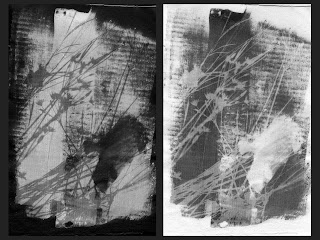
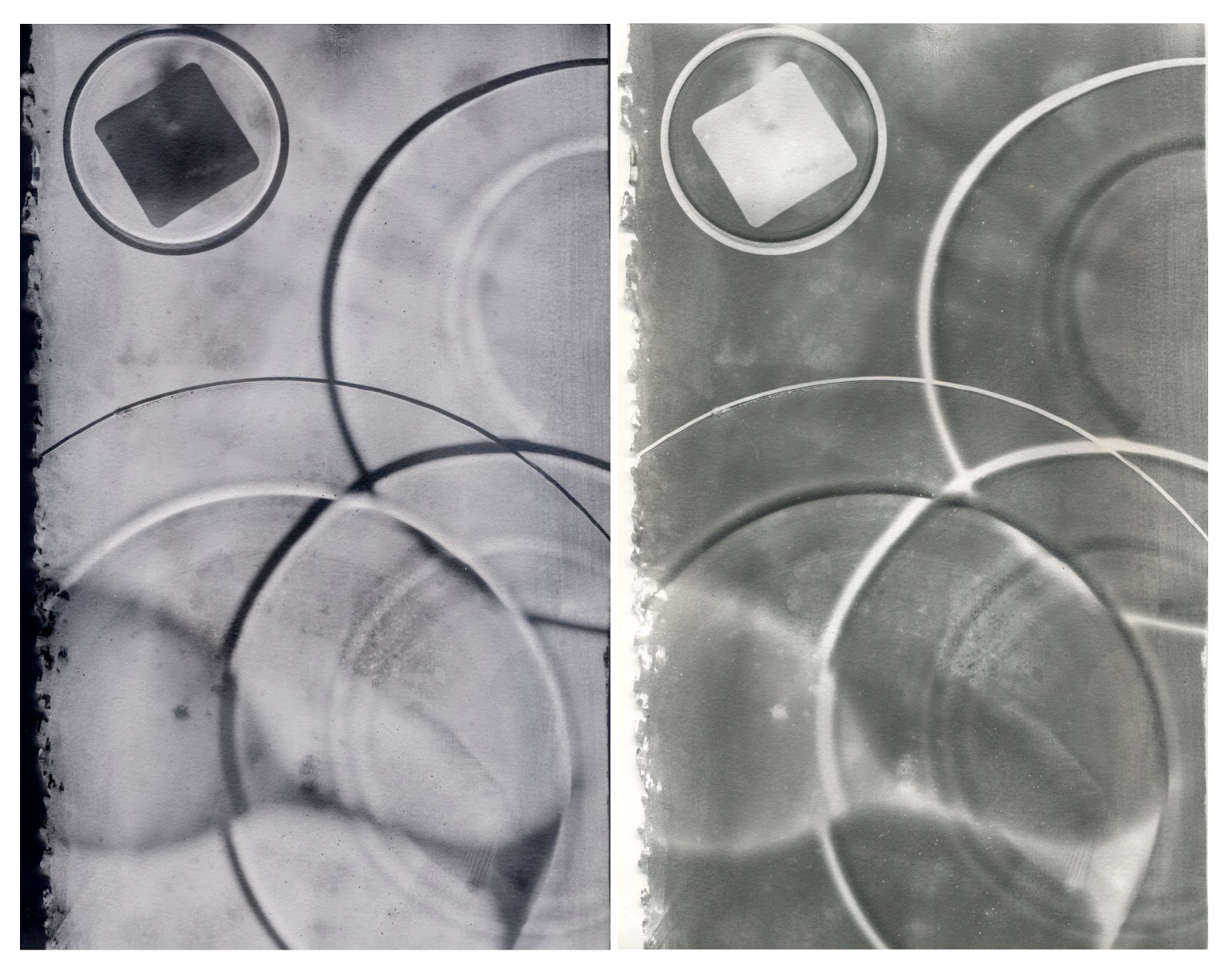
The first images I decided to do were basically tests of different
materials: glass and organic plant matter. The glass I printed on
watercolor paper and the grass I printed onto the Walmart fabric. I had
painted the emulsion of the fabric on a piece of cardboard, which gave
me the happy surprise of seeing the corrugated pattern appear in the
image. Painting the emulsion with a brush also gave a nice brush
texture to the image, which is cool. The images on the right were the
positive prints produced by the emulsion, and the images on the left are
the digitally inverted versions of those. I have two plans as to how
to achieve this, which I will test soon. One is a contact print, which
is where I would lay the positive print over an unexposed piece of
fabric and expose that directly to the light, theoretically getting a
negative print of the positive image. The other is using a small print
of the positive image that is inserted into a small projector that I
bought at Michaels which will project a large image of whatever is
placed beneath it onto the wall. Doing this would also, theoretically,
give me the result of an inverted image.
Now came the question of what to do with the canvas I had inadvertently painted with fogged emulsion. Since I knew I wasn't going to get the nice bright whites of a pure silhouette, I decided to experiment with some chemogramming, which is mixing the different processing chemicals to achieve specific effects. I grabbed a plastic bag and some more grass and a miniature of a sculpture from a previous project and laid them onto the canvas, and then loaded a paintbrush with the fixative and splattered it onto the canvas. After waiting a few minutes, I exposed the emulsion and developed, and just as I had hoped, the fixative had prevented to fogged emulsion from developing, and I was able to maintain some pure whites in the image.
This is the inverted image of a print I produced last week, which I feel is more effective. Hopefully, using either contact printing or the projector I will be able to achieve this.
Labels:
art,
darkroom,
modern,
photogram,
photography,
silhouette
Subscribe to:
Posts (Atom)