Showing posts with label photography. Show all posts

Sunday, August 31, 2014

Camera Experiments


I went out to a park in Los Angeles up in the hills originally to test out my new Canon 60D photographing skaters in a small skate park, but as usual reverted to abstracting my surroundings.  All of these images were created solely in camera, with only some minor color adjustments in Lightroom.  No filters or composite layering of any kind were used to create the images.  It truly is amazing what long exposures and inducing camera flaws can produce!

Sunday, March 03, 2013

More Intuition Drawings

Intuition #4

Intuition #3
These are a few more intuition paintings I did over the weekend in preparation for my final project proposal for my Contemporary Art Studio Seminar class.  In terms of Semiotic communication, these pieces are descriptors of my body in terms of Index, which is a physical symbol made by its signifier ( i.e. a fingerprint as representation of a finger).  Literally, my body is imprinted in the photogram leaving both an Iconic representation of my physical body as well as a physical Index.  These photograms are placed on top of layers of materials which become a representation of my intuitive interpretation of my identity within the time period I meditate on.  I am interested in examining the way my conceptual identity changes as I work on these pieces, for I find that I am constantly defining and redefining myself in memory.  How does this fluid self-interpretation relate to my current body and how do the materials I intuitively select to create the grounds of the painting redefine my present?  Connected by a similar thread, in what ways are these objects represented in proportion to one another related to my body, as in how are the materials and methods proportionally and methodically distorted by the misconceptions inherent in my thinking?  I know this is a lot of theoretical jargon, but it is necessary to understanding how my art relates to modern aesthetics, and I need to be able to discuss my work in these terms in order to communicate and more clearly understand where these images come from.  If anyone would like to know more about these Indexes and Icons of representation, you can refer to this Prezi I made on art in relation to Semiotics.

Intuition #3: Reaching for myself through fear, foundations of medical paraphernalia weaving, stitching, and creating structure for my body.  If you scratch away the surface, you can see the layers and layers of evidence of what my body requires to function, and what I must consume to live.  My skin becomes a focus here and an obsession, as it both covers the marks of my injection sites, builds as scar tissue, and deteriorates in ultimate lipodystrophy.

Intuition #4:  How do I measure the worth of my physical appearance?  How do the physical side effects of my diabetes magnify and distort the imperfections in my body and how do I show the looming fear of what will become of my body in the future?  How much of my life is defined by this fear and is it the underlying motive behind most day to day decisions I make, and is this intensified by the affects of gay culture where looks are regarded as wealth?

Tuesday, February 26, 2013

Intuition Experiments

Intuition #1
Intuition #2
    Here's a post about something different that I am trying.  In talking with my thesis advisers and examining my own intuition about what to do for my projects this semester, I've found myself moving away from photogramming that demonstrates specific moments of my past and more into imagery that examines my present interpretation of my previous experiences.

    When I completed my previous works, I had always had a specific plan in mind which was almost immediately debunked upon the completion of the piece.  It seems as if my work needs a more fluid and malleable interpretation that is not constructed from a rigid plan; in all honesty the art does not want to be concretely directed and instead wants to flow uninhibited from me and into the world.  There is always a battle which occurs within my head about what my MENTAL processes want the imagery to look like and what my BODY actually creates.  This can be quite distressing at times, and indeed I looked upon many of my works of last semester in utter despair before closer examination revealed a new lens through which I could view my past.  The ability of my mind to impede my body is not something which I feel will be productive in the macro perspective of my future, for I know myself well enough to  ultimately see frustration winning over my desire to create. 

    With this in mind, I have begun taking steps to exercise the surrender of my mind to my body and its intuitive nature, which has indeed proven to be difficult.  I feel that my works this semester want to be large, and while I entertain the romantic notions of an uninhibited pursuit of art I do have to remember that I'm a broke grad student with limited resources at hand.  This is where my handy iPad comes into play!  It allows me to draw, paint, and conceptualize prototypes without any fear of waste or irreversible mistakes.  The images I have posted are two intuition experiments that I have completed, where I physically engage in art and remove my mind from the process, working entirely by intuition and emotion.  I do have a few new themes that I keep way in the back of my mind to give my body a purpose, but I am working to minimize the extent to which the theme dictates the imagery.  I know I want to not recreate moments, but to illustrate how the moments felt without being too heavy handed with strict narration.  For example, in college I began to obsess over my body due to several factors, including the inevitable erosion of my body due to my diabetes and my superficial worth as an attractive homosexual man.  I don't want to say to people: my body is deteriorating and I suffer from dysmorphia, but rather: this is how my deterioration feels to me and this is how my physical obsession feels to me.  This is far more personal and moves away from the realm of the pedantic, which has been a constant struggle in the past.

    And so I look to methods of measuring my current emotional interpretation of my undergraduate development, which I'm positive will change as I work on my pieces and that I hope will remain evident in the final product.  You will see not an illustration of a single event, but evidence of a pursuit of discovery that is traceable throughout the surfaces of my art.  With what materials I will use to realize this I'm not entirely sure yet, but the question of which forces carved the deepest trenches in the construct of my personal development will provide the clues I need to decide.

Wednesday, February 13, 2013

Photogram Painting

Here is my first experiment with new materials incorporated with my photograms.  I've uploaded a process photo, since this methodology involves several stages of development. 

Fist, I experimented with the ground on which I would do the photogram.  I found this awesome gesso at Michael's that, although a bit pricey, has the awesome effect of shrinking as it dries and thereby distorting the canvas and cracking.  Since this semester I am focusing on the erosion of the body and false identities, this seemed like the perfect material to experiment with. 

Secondly, I began a painting with no particular image in mind.  Mostly, I wanted to choose colors and strokes that were tuned directly into how I felt.  I began with warm colors and smooth gradients in the top right, but as my OCD sank in and I began obsessing over details, the motion became broken and circular with a colder and darker palette, which created an image very similar to the perpetual storm on Jupiter's surface.  I was not satisfied with the piece with just paint, however, and I felt like the darker area needed something else, something that reflected the weight and pressure of the manic desire for perfection.  So, I went outside and started pulling up grass and weeds, covered the canvas with glue, and threw it on and painted it in.  This enhanced the feeling of mania and hysteria for me, and connected a medium which I was in complete control with materials directly from nature that I attempted to force into my creative logic.

Lastly, I incorporate my body directly into the image with the photogram.  In the case, the emulsion literally becomes a mask, covering the color of the paint in black but unable to completely adhere to its underlying surface, much like my previous piece Touched

I'm not entirely sure how I feel about this piece, but I know that it needed to be created and that my future works will in some way be influenced by what I learned here, and that may be the most important thing.  I've learned more through my failures in the past year than I have in my successes, and though the lack of concrete "progress" in my mind can be infuriating, it is nevertheless necessary.

Tuesday, January 29, 2013

First Test Piece of the Semester

    Here is my first test piece related to my new series of photograms for this semester.  It is definitely a work in progress, since I am attempting new methods with the projection of images as opposed to just silhouetting my body in addition to the sculptural elements, and I feel like this may take a similar path to the beginning of last semester: I try to assert myself and tightly control compositions with this new and intimidating methodology until it ultimately breaks down and reveals something truer than I could have purposefully created.  
    I attempted to project words from my journal onto this fabric, but due to the luminance limitations of the projector nothing appeared in my first attempt, so I tried a double exposure and ended up with a gray mess (although there may be something profound in that no matter how hard I tried I couldn't get the words onto the fabric).  I then took the cloth and attempted to mold it to the plaster hand I created last week, and ended up with a faint impression of an object beneath the surface, which is what I wanted.
The piece is raw and unrefined, but I think that's okay.  Whatever I create from this point could not come into existence until this piece had been let out of my mind, and it is only the first step in what promises to be a frightening and illuminating journey over the next 15 weeks.

A New Darkroom!! II.

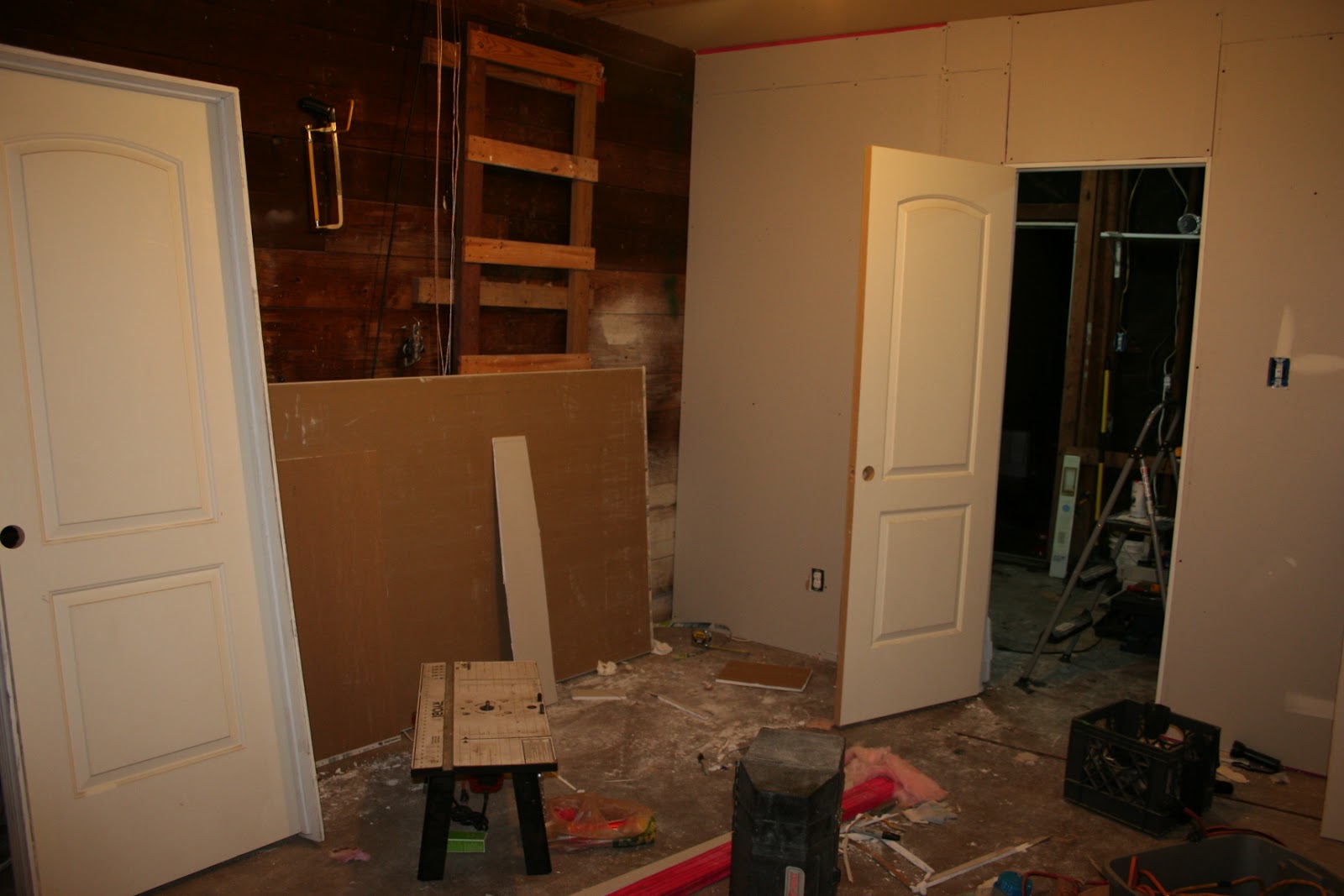
    The biggest challenge in building this room is the walls.  The current walls were left with open studs and visible tar paper, which had developed large holes from previous tenants nailing things, which is definitely no good for a darkroom.  So, we will be upgrading the structure a bit by building new, insulated, sheetrocked, and taped walls.  There was also a bit of electrical work to be done:  There was only one light, whose switch was to the right of the garage door (horribly inconvenient).  We moved the switch to the interior of the space, and added and rewired some electrical sockets, which you'll see later.
    We never use the garage door at the front so we just decided to wall it off, which meant removing the tracks for the door, building and insulating a wall and even a portion of the ceiling, which was difficult since it came up at an angle from the top of the door.  We also added a layer of plastic to add additional weatherproofing to the numerous holds in and around the door frame.  Boy oh boy has this been a LOT of work!!
    To stabilize the walls we needed to shoot bolts through the floor tracks and into the cement foundations.
    This is a shot from the interior of the room.  Thankfully the one wall that divides the garage from the house is solid enough that we don't have to build a new one.
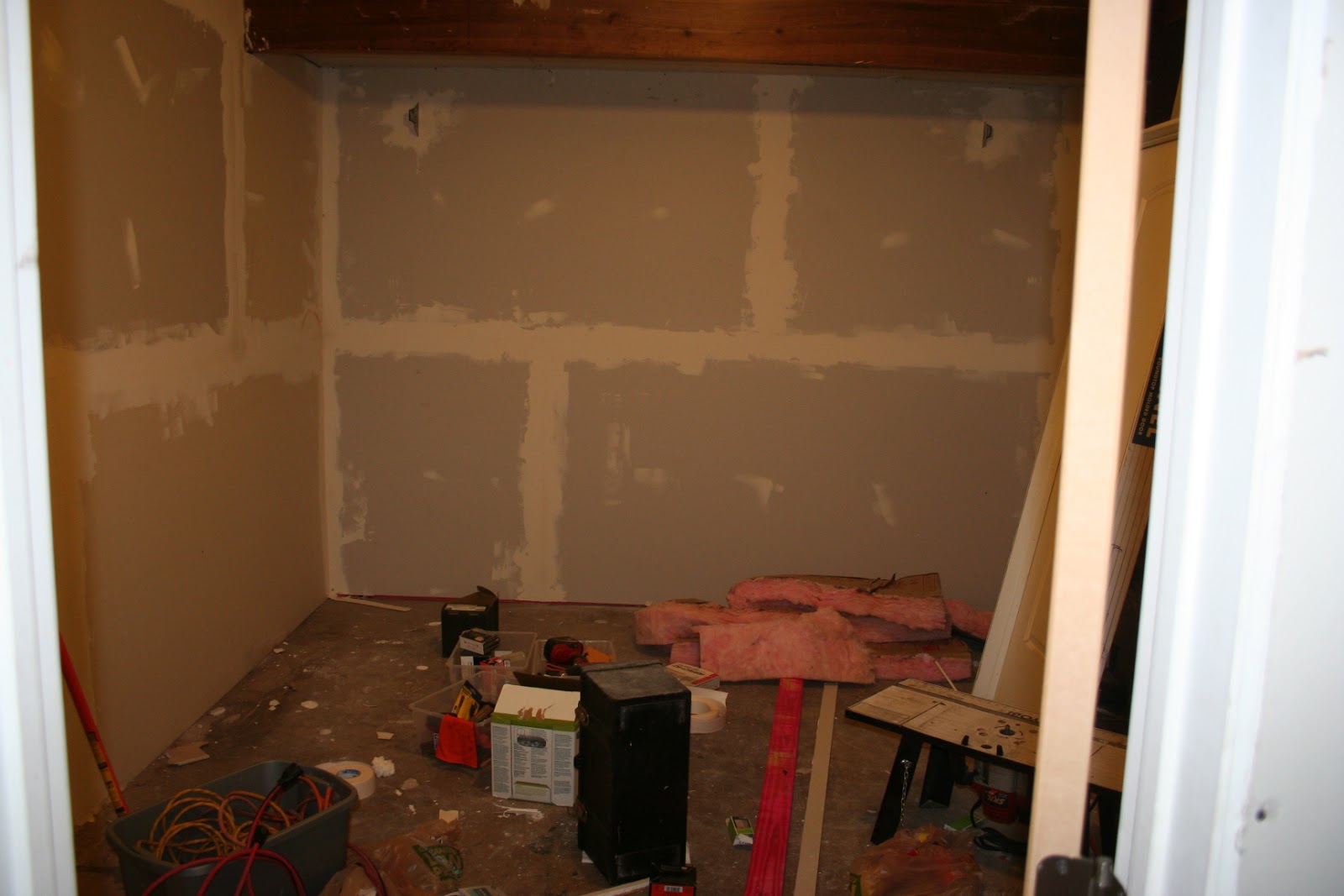
Here you can see the current stage of the room, which is floating and taping all the seems between the sheet rock and filling in any holes we created while drilling them into the studs.
 This angle of the garage is the same angle as I showed in the previous darkroom post that you can see here.  There was no source of light for this side of the room, so we had to add two florescent lights in the ceiling, as well as adding some plug sockets near the bottom.

There is still at leas one solid weekend of work to do before the room is useable, but Gavin and I work well together and can get a lot of things done when we set our minds to it.  I am a little worried I have overstretched myself a bit, with taking Image Synthesis AND trying to complete the lighting work on the short film Sleddin', but hopefully it will work out great and I can make some rockin' art!

Saturday, January 19, 2013

Continuations and Expansions

This semester I will be continuing with the themes and concepts I established in the fall, but this time the subject matter will be what I consider to be the third era of my life. This period covers everything from my high school graduation and move across the country to Rochester, to the events leading up to my coming out and personal acceptance as a homosexual, my first love, and the struggles I faced in molding myself to seemingly impossible standards as a professional artist in the animation industry. When I look back on this time, I feel as if it was a rebirth and a new found infancy where everything was possible and yet horribly frightening. There were no chains to bind me except the ones I clung to from my past and the complexity of my internal struggles expanded to encompass wondrously new territories. I can reduce this bubbling concoction of experiences down to one simple word:

 Emergence.

And so, with this new foundational concept, I have begun to examine the natural progression of form that would support my new themes. My works of last semester were primarily flat pieces that focused on images illustrating my struggles with the concealment and misdirected projections of my identity. This new theme calls for something more concrete and spatial, as it is one step closer to discarding the illusions that I had tried to maintain and, in truth, was the first time I openly invited others to peer beyond the screens of my fears.  The realization of these forms will be similar to my previous photograms with two exceptions:


1) I will be molding the fabric to my body so that it retains its shape, yet remains vague in terms of concrete detail.  The hand in the above picture is a test I did today with plaster bandages and is similar to what the fabric will look like.  You will see the form of my body as if there was a figure present underneath the fabric, still concealed but infinitely more concrete than the abstracted silhouettes of before. 


2)I will also be taking a more literal turn with the photograms by enlarging and projecting text from a journal that I had kept during college.  This act in itself is a huge leap for me in revealing things that I have yet been petrified to show. 

I hope to create a dialogue between the expression of my internal thoughts and physical manifestation of my body that reveals as much to me about this period of my life as it does to others.  It is an act of catharsis as well, for there is a lot yet left to express that has been pent up in the fortresses of my fears.  This semester will be a journey, hopefully a brutally honest one, that will allow me to openly discard my projections and reveal an intimacy that is closer to the truth of my identity and, hopefully, pave the road for a truer form of expression as a professional artist.

Wednesday, December 19, 2012

MFA Show Walkthrough

2012 MFA Fall Show walkthrough from gunslingers19 on Vimeo.
Texas A&M's Master of Fine Arts in Visualization has their 2012 Fall show in Langford C's Studio A.

For those of you who like to see art in a more live setting, I did a video walkthrough of the show.  The video cam out a little fuzzy, so I apologize.

Highlights from my work in the 2012 MFA Show


Imprints
My work demonstrates intimate realities that flow behind the façades I project into the world.  In conceptualizing these images I call upon the emotional undercurrents that clash with the carnal self; a self that enables one identity to conceal another.  Using a photographic emulsion and artificial light, I capture in silhouette the presence of my physical body.   The processes and surfaces resist my control; the resulting abstraction of the literal form articulate the otherwise concealed emotional and psychological structures.  The frustration of my inability to fully determine the outcome appear in the image as flaws, tears, fingerprints, and inadvertent patterns that communicate the dissonance between internal dialogue and outward appearance, revealing without my permission that which I had longed to hide
-R.J. Peña

Saturday, December 01, 2012

Tortuous

There were many times in my teen years that I felt trapped and overwhelmed by an intense sensation of loneliness which was often magnified by the opposing pressures of conforming to normalcy and natural desires.  For the most part I was able to keep these feelings at bay during the waking hours with my obsessive over achieving, but during the night when all of my distractions faded away and all that was left was me and my mind, I endured an overwhelming deluge of emotions from claustrophobia to depression, anxiety, and loneliness.  The periods of pain were such that all I could do was clutch my sheets and curl into a ball, riding the torrents until they inevitably subsided.

In conceptualizing this piece, I wanted to bring all of the factors leading into these events into the image and use the resulting contortion of my body to disturb the surface that my form is projected upon.  When I felt myself returning to these memories, I clutched the fabric and curled my body much like I did when I was younger and was able to capture not only a physical representation in the imagery, but a tactile distortion of the surface that mirrors the dissidence within my mind.  The folds created during the performance fracture and distort the proportions of my limbs and demonstrate my warped psychology.

When I viewed the completed piece with my professors we again experimented with rotating the composition to determine if there were any significant emotional/compositional changes and I was delighted to discover that the perceived emotion shifted based on the orientation.  The top left (also my favorite) feels as if the figure is falling and has been swept away by a torrent, the top right as if the figure is trapped within a box, the bottom right begins to introduce a sense of violence, as if the figure has been pushed or knocked over, completely losing its balance, and the final conveys the greatest sense of violence with the figure appearing to have landed roughly on its head.

Wednesday, November 28, 2012

Accident


So, as I have mentioned before, the process of working with the emulsion in the darkroom lends itself to many unintentional results.  There is a lot of fumbling around and bumping into things, and, especially in the case of painting the emulsion on the fabric, it is impossible for me to tell which areas have been covered and which have not.  This leads to me having to work intuitively, guessing and obsessing over areas that I feel have not been covered enough in accordance to what I plan to do with the image.  Much of my emotional state of mind is captured here, for if I am stressed my process is frantic, or if I'm careful there will be areas of evenly applied emulsion.  In this case, I was obsessive over the area I knew a particular part of my body would be which is evident in the area of thick, dark emulsion.  Somewhere in the process of setting up the light for exposure the dimmer switch got lowered, and so when Jace activated the light it was dimmer, not noticeably so, but dim enough to where when I painted the developer on the surface nothing seemed to happen.  At this point I panicked, and not being able to tell if I had accidentally painted on fixer instead of developer I grabbed the other container of chemicals and painted them on as fast as I could.  I didn't discover that the cause was the light until much later, and the effect of fixer mixing with the developer that was heavily soaked into the fabric produced this result: a completely abstracted image that appears random, but in actuality is directly influenced by my body and psychological affect during it's creation.  My body is present in the color variation and in the surface of the fabric, where the drying emulsion preserved the wrinkles I created, and the patterns and uneven emulsion describe my frustration and stress.  

When examining this piece in class, we decided to rotate the fabric in every possible orientation in order to observe how the compositional elements were affected by direction.  Surprisingly, this piece works in all four orientations, with different elements being either highlighted or diminished depending on your point of view.  What appears to be an abstracted open landscape in one sense may transform into a ruined city when reversed, or when the surface appears to be the star of the piece may suddenly become subdued by the emulsion pattern and distribution.  This is very exciting and something that I will continue to explore in other pieces.

Tuesday, November 27, 2012

Shift

I had mentioned in the last post that a piece I did a few weeks ago had led to a dramatic shift in the way that I approached the work I was doing.  It's been crazy busy, and so I haven't been able to update in the last few weeks, but now I have some breathing room and here is the post ! :)

There were a lot of unexpected results with this piece, being my first attempt at a full body photogram and my first experiment on the raw fabric that I have been purchasing.  The worst horror that I experienced was that because of the absorbance of the fabric, the emulsion did not spread evenly, which is the the cause of the random streaking.  In addition, I lacked a large container to process the fabric in so I had stuffed it into the gallon container containing the chemicals, and all of the excess silver soaked into the fabric and caused all kinds of weird green residue to appear.  On top of all that, you could BARELY make out a ghosted image of my body, and in my mind this aberration was a complete disaster due to my failed attempt at creating the image I had planned.

The next day I brought the piece in expecting harsh criticism, but instead was met with praise.  I was  confused by this and was unable to understand what my professors saw in the gross deterioration I saw before me.  However, upon discussing the piece with them, I came to understand that there is a performative aspect to this work that gives it a depth of meaning and interpretation that I had not anticipated.  In the patterns of the strokes you see the result of my intuitive gestures, and in the wrinkles of the fabric where I laid my body you see the physical evidence of my presence on the material.  In this way, my body becomes the medium and the emulsion captures a shadow converses with the physical manipulation of the surface.  I have never thought of art in this particular way before, in the performative, and I now understand a new way of creating images that are capable of revealing through chance more than I can ever plan to reveal.

Monday, November 05, 2012

Touched


    So now I've gotten comfortable enough working with the emulsion that I've begun to do more large scale works, even though using so much of the emulsion at one time kind of makes me cringe!  The last piece I completed, which I will post about later even though it did not turn out anything like I had planned or expected, had revealed an entirely new direction in which to take my art.

    In this piece, titled Touched, I draw upon one of my most vivid and powerful memories: the events leading up to my first kiss.  At this point in my life, I was struggling greatly with the knowledge of  my sexuality and the fear of the consequences from my family.  My father vehemently forbade any expression of being gay,and forced me to go to therapy in order to correct the mental illness I was suffering from.  However, myself, being as strong-willed and bullheaded as he, knew that this was not going to change.  I had known my orientation from the age of 10, and had spent the previous 5 years concealing it and dealing with the emotional consequences on my own.  But this suppression had a backlash, creating an obsessive desire to find someone, to touch, to express these terrible desires that were forbidden, and yet pulling at my core as potently as the need to survive.  I finally found someone who was capable of returning my affections when I was 15, and you cannot imagine the excitement, the relief of knowing I was not alone, that overwhelmed my senses.  Yet even still, I was terrified of my father and of what could erupt upon the discovery of this treasure.  And then that summer, at a friend's birthday party in Galveston, I found myself outside with him out on the patio overlooking the ocean with a strong warm breeze washing over us and the sounds of the crashing waves drowning out everything but us in this electric moment.  The year had already been difficult, with me coming out to my parents and dealing with depression and isolation and the constant threats from my father to both of us.  So at first we were just talking, each safe in our own sleeping bags, but the longer we looked into each others eyes the more irresistible the pull became, until suddenly we were holding each others arms.  Each of us were so desperate to touch one another and share this simple contact and yet so horrified at the thought.  Him with the backlash of religion and me from the strong boot of my dad pressing on me.  The strain of energy coursing across my nervous system was so great I felt as if I could burst at any moment.

And then he kissed me.

There has not been another moment in my life when the touch of another has filled me with so much thrill, so much wanting and need, than in that moment.  Every single detail of that moment and the unimaginable bliss that someone could want me as badly as I wanted them for the first time in the five years I had suffered alone has never faded from my memory, and it is due to such things that I now feel the confidence in myself to express in my art. 

    Here was my process:
I laid a foundation of an oil based primer with my hands upon cloth, using my body to throw and spread the paint, leaving traces of my palms and fingers across the material.  I then used a paint roller to cover this with emulsion, almost erasing the traces with the medium I would then use to capture my body and that of Gavin, in the position that mimicked my memory.  Because the emulsion was a bit tacky, and because it could not bond properly with the oil primer, the contact with our bodies loosened it and caused it to tear where it contacted our skin, and later while processing, giant holes appeared.  The image has become a mirror of the emotional turbulence I felt: a suppressed desire to touch, covered with a superficial appearance that was slowly degrading under the power of this basic need.


Thursday, October 18, 2012

1st Pieces for "Beyond the Screen"


    I did it!  I got the wonderful Jace Kerby to model for me, and composed my first human shadow captures in my darkroom.  The piece on the left is titled "Is Someone There?" and the piece on the right is "I See You,"  and I feel as if the pieces compliment each other.  The original images are the ones with the white silhouettes, of course, since I haven't mastered the process of turning the negatives into positives in the processing, so I'm going to get the digitally inverted images printed at the same size as the original.  I know, the aesthetic will not be the same, but it's fascinating when looked at in terms of the simulacra and appropriation.  Each step in the process delivers an alternate perspective and challenges the verisimilitude of the images which preceded it, and in this light I am left wondering which presentation is authentic in its representation.  The dialogue between my thoughts and the image intensifies the intent of the subject, the emotive response, and the awareness of voyeurism.
    What strikes me about these two together is the position in which the viewer is placed in the narrative.  In Is Someone There? I feel as if I'm am the voyeur, intruding into the privacy of another who is yet unaware of my presence.  There is an apprehension that I will be caught, yet the desire to remove the screen and observe the mysteries beyond entices me.  The brush strokes and imperfections reinforce the illusion of a veil between me and the subject which becomes ethereal beneath the weight of my gaze.
    In I See You, this position is reversed:  now I feel as if I am the victim of the intrusion, threatened by the gaze of an unknown other beyond the veil.  I am struck by a desire to rip down the screen so that this unknown may be recognized and I may objectify the foe, therefore reclaiming the gaze that has been forced back upon me.  I find myself recoiling, almost ashamed, as if this perpetrator has caught me in some unseemly deed when I believed no one was looking, and I am reminded of the gaze of the Other and the need to hide myself behind the mask of a projected identity.

Tuesday, October 16, 2012

Finally Time for Some Art!

    This weekend was full of trial and error and retrial and more error, set on repeat.  There were lots of bugs to iron out with the darkroom, including but not limited to: faulty emulsion adhesion to the canvas, inconsistent fogging of the images, weird brown aberrations that appeared a few hours after fixing the emulsion, and the emulsion softening and becoming gel-like during the washing phase.  Here are a few images related to the errors:
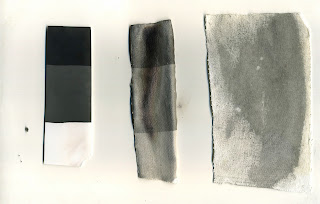
    The image on the left shows the first tests I did on a few different materials.  The one in the middle is the artist's canvas I bought from Hobby Lobby, and the times of exposure on this strip was 3 seconds, 1.5 seconds, and 0 seconds..  One side is primed with some kind of gesso, probably acrylic.  A major issue we had was that the strips curled tightly upon developing and fixing.  I'm guessing this has to do with the developer affecting the acrylic primer, softening it and causing the fabric to distort.  The portion in the center that turned a weird black/brown color was where the emulsion was applied too thickly, and I believe the fixer was not able to penetrate into this area, causing a slow reaction hours after I brought it out of the darkroom.  One of the first errors I noticed was that the unexposed portion greyed significantly, which meant I had a fogging issue with one of the safelights in the darkroom.  To test this I got normal photo paper, turned off the Patterson Safelight on the desk, and exposed with the same time.  This is the test on the left.  With the Patterson Safelight off, I got no fogging. 
   Thinking the problem was solved, I stretched some rough white fabric that I purchased from Walmart (for a fraction of the price of the canvas from Hobby Lobby!) over a frame and coated it with the emulsion, and then I did two more strip testsjust to be safe.  The length of expousre was 1 second per region, up to 15 seconds.  The long strip on the left had 1 coat of emulsion, and the strip on the right had 2, just to throw in another variable.  The result had both unexpected and expected results:  Neither strip curled during processing, which was great news.  The strip with 2 coats and a deeper contrast range, which is definitely good to know, however added layer of emulsion softens immensely while washing the fixer off in water, and actually came off while I was patting it dry with a paper towel, which you can see in the middle.  One thing I was frustrated to see, is that the unexposed portion STILL managed to get severely fogged.  So I decided to do another test:  First, I put a paper towel over the opening of the overhead safelight to dilute the light even further.  Then, I coated the same Walmart fabric with 1 coat of the emulsion and developed it without exposing.  The result is the right piece of fabric in the leftmost image.  As you can see, there was a strange inconsistency in the tone of the image.  What I realized, is that before I stopped using the Patterson safelight, I had been coating strips on the desk near the light and, thinking myself frugal, was pouring the excess emulsion back into the bottle, and thereby unknowingly contaminated the whole bottle with exposed emulsion :(  However, now that I solved this, I could FINALLY move on with creating some art!
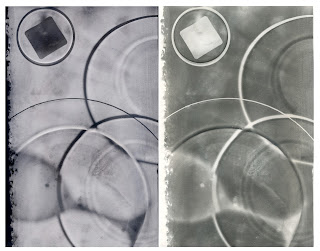
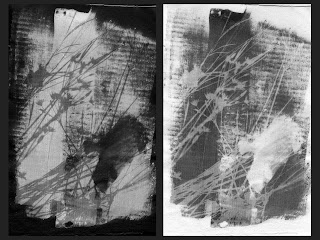
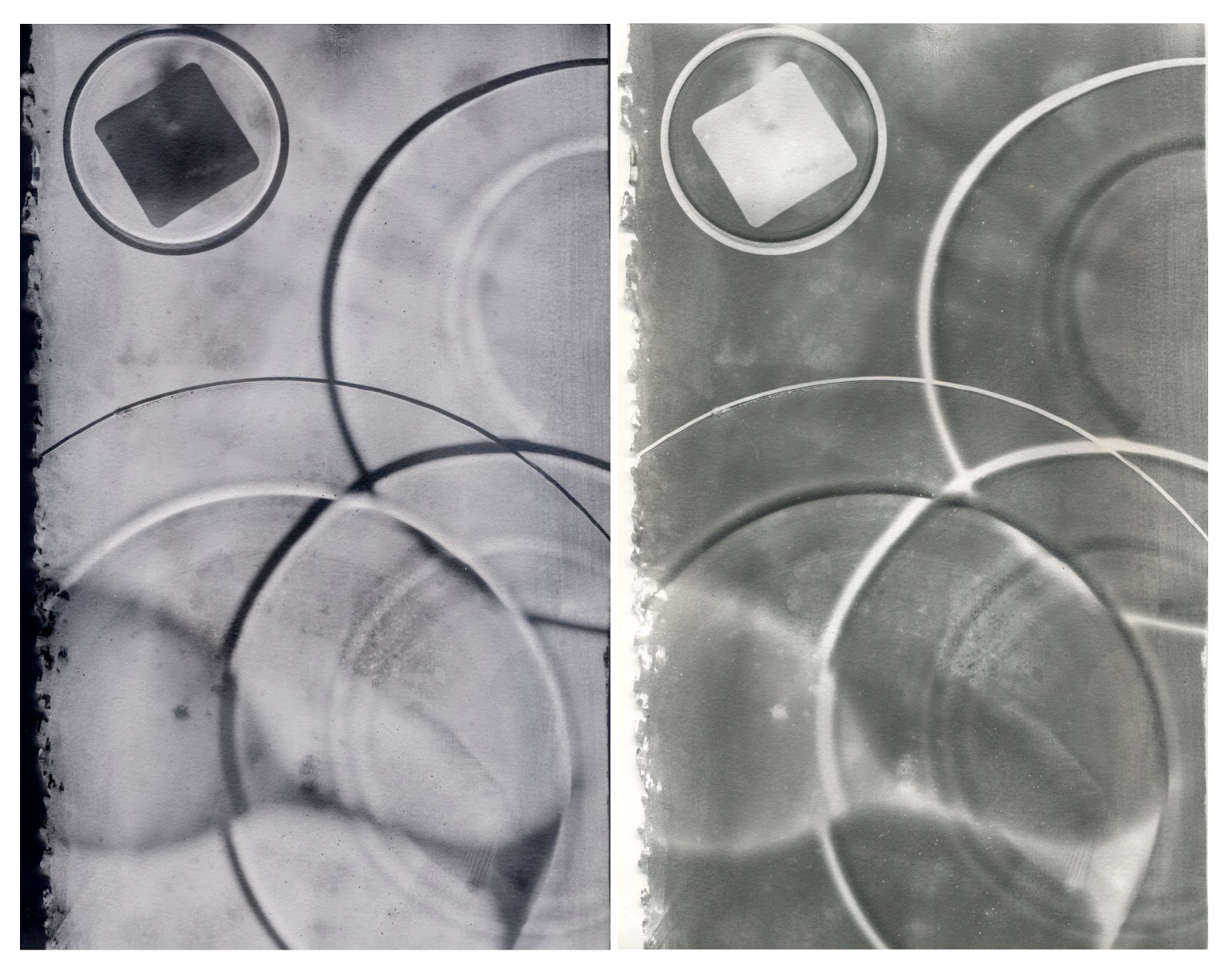
    The first images I decided to do were basically tests of different materials: glass and organic plant matter.  The glass I printed on watercolor paper and the grass I printed onto the Walmart fabric.  I had painted the emulsion of the fabric on a piece of cardboard, which gave me the happy surprise of seeing the corrugated pattern appear in the image.  Painting the emulsion with a brush also gave a nice brush texture to the image, which is cool.  The images on the right were the positive prints produced by the emulsion, and the images on the left are the digitally inverted versions of those.  I have two plans as to how to achieve this, which I will test soon.  One is a contact print, which is where I would lay the positive print over an unexposed piece of fabric and expose that directly to the light, theoretically getting a negative print of the positive image.  The other is using a small print of the positive image that is inserted into a small projector that I bought at Michaels which will project a large image of whatever is placed beneath it onto the wall.  Doing this would also, theoretically, give me the result of an inverted image. 


    Now came the question of what to do with the canvas I had inadvertently painted with fogged emulsion.  Since I knew I wasn't going to get the nice bright whites of a pure silhouette, I decided to experiment with some chemogramming, which is mixing the different processing chemicals to achieve specific effects.  I grabbed a plastic bag and some more grass and a miniature of a sculpture from a previous project and laid them onto the canvas, and then loaded a paintbrush with the fixative and splattered it onto the canvas.  After waiting a few minutes, I exposed the emulsion and developed, and just as I had hoped, the fixative had prevented to fogged emulsion from developing, and I was able to maintain some pure whites in the image.

     This is the inverted image of a print I produced last week, which I feel is more effective.  Hopefully, using either contact printing or the projector I will be able to achieve this.

Sunday, October 07, 2012

The Darkroom is Complete!


Here it is!  This finished darkroom.  The final touches were stapling the internet cable along the bottom of the wall and filling in the light leak from the hole it came through and a few smaller light leaks that remained around the windows.  I discovered when light directly hit the side of the house the foam board actually became semi-translucent when your eyes adjusted to the dark, so we ended up having to put some of the ram board we bought for the floor over the foam board, and then just for good measure put some foil tape around the perimeter just to make sure absolutely no light would creep in.  I mixed the developer and fixer in two tupperware like pitchers with airtight seals, which I believe should be safe enough for the chemicals.  The one Patterson safelight that I bought isn't quite strong enough to give me enough light to work in, so I'm going to hit up a photo supply store out in Houston for a bulb that I can put into a standard lamp, which should give me the illumination I need.
 We ended up having to reverse the swing of the door into the room because it was too difficult to come in and out without disturbing the curtains, which was a light leak threat.  This way you are able to open the door, step into the light lock, close the door behind you, and then go through the curtains.
And here is my first attempt at photogramming!  For whatever reason, either proximity to the light or the intensity of the bulb, the paper seems to be ultra sensitive.  My first attempts at doing exposure strip tests at 1 second intervals produced completely black strips.  This image was created literally turning the lamp on and off almost instantaneously.  I think tomorrow I'm going to go back to Home Depot and get a much smaller bulb at the lowest wattage I can find and test that out to see if I can get a little more flexibility with the timing.  I created the image using my hand and shreds of a plastic Walmart bag, and painting the developer onto standard photo paper.  Because the paper has such a high gloss, the developer tended to pool in little puddles, which is where the white holes in the image come from.  Also, a bit of a happy accident, the words printed on the bag just happened to appear directly parallel to my arm.  There is something very appealing about that in combination with the form of a hand grasping through the silhouettes of the plastic bags...I think I'll explore some of that later.

Building the Darkroom

This week I gathered materials to convert the spare bedroom in the house to a darkroom.  The biggest challenge for this project was going to be sealing off all the windows to prevent light leakage and constructing some sort of entry/exit mechanism to lightproof the area around the door.


So first we cleared most of the furniture and clutter our of the room and off the walls, leaving the desk so I would have somewhere to put the trays of chemicals I will need to use for the photograms.

Sealing the windows was actually fairly easy.  All we needed to do was buy some insulated weatherproof board, cut it slightly bigger than the height and width of the window, screw it into the drywall, and caulk around the edges.  That created a good enough seal to keep out the light.  For this window in particular, we will later be installing a standard bathroom vent type device to ensure good ventilation.  For that, we would need to keep the window slightly cracked at all times (which is why we got the weatherproof board, and cut a small hole in the bottom of the foam board so that the vent can suck air through the space in between the board and the window.  Since the mechanism for the vent will be outside and going over the window, we should be able to seal the edges in a similar way to prevent light leaks.


For the door, we bought some PVC pipe and blackout curtain material that we made two makeshift quarter-circle drapes out of.  To mark where the drapes were going to go, we held a Sharpie against the door and let it mark the ceiling as we opened and closed it to see the area the door would need to travel.  We ended up having to break the pvc pipe in a few places to get the curve we wanted, so to hold the pieces together we threaded some rope through the pipe and then rolled the curtain over to lock it in place.  We then screwed the pipe into the ceiling with drywall lock screws and attachments and attached the sides of the curtains to the drywall by screwing them into some spare pieces of board we had laying around.  Against the bottom of the door we attached a weatherproofing strip so that no light could leak in through the bottom of the door, where a large hole had been chewed by a mouse at some point or another.

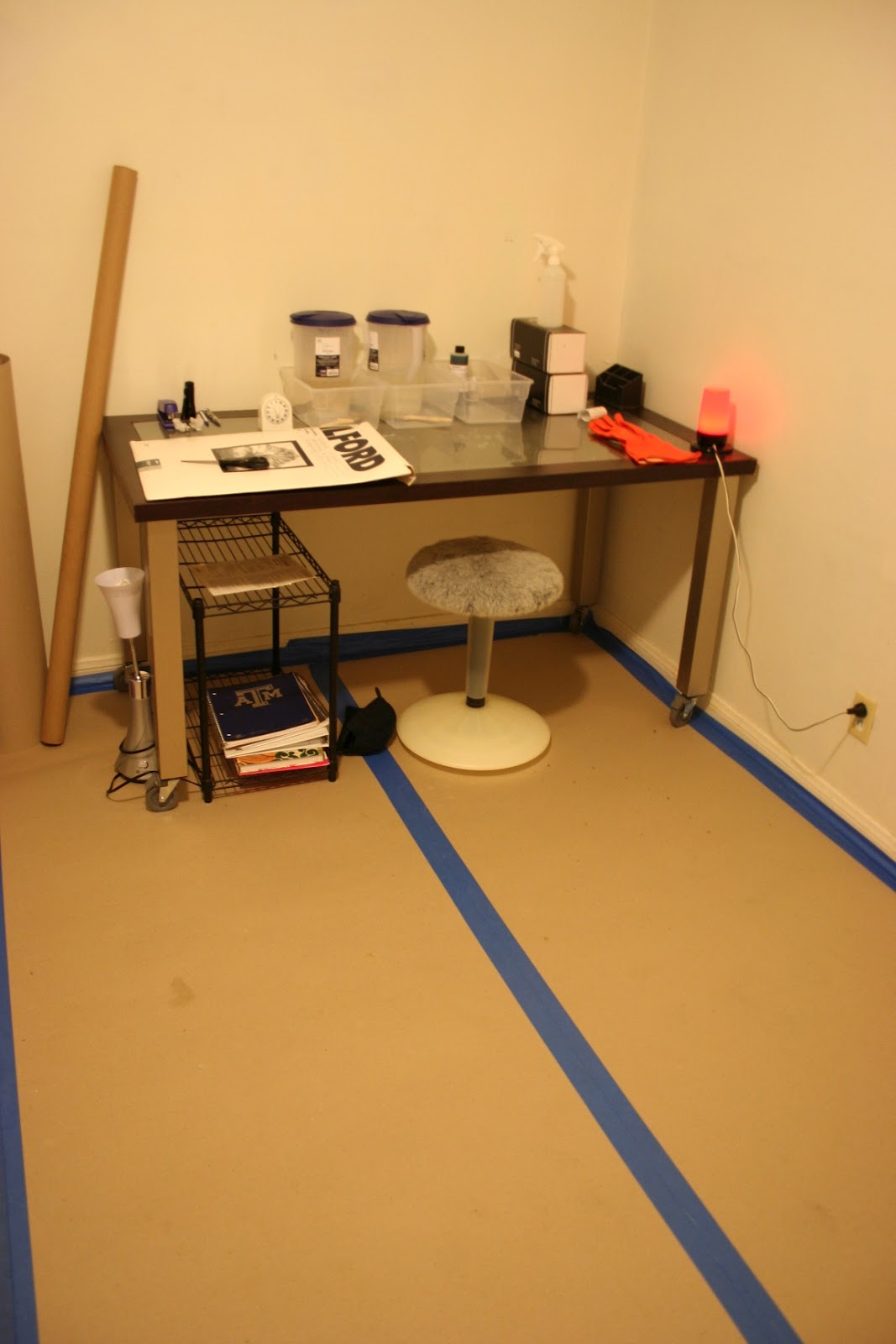
This is the desk that we left in the room to use as a worktable.  The three plastic bins near the wall are what I will be using to store the chemicals and paintbrushes while I'm working.  To the left of the table you can see a large roll of thick brown cardboard.  I'm going to use this to protect the floor by laying out overlapping strips along the ground and stabilizing it by taping it down with blue painter's tape.  The cardboard was relatively cheap so it will be fairly inexpensive to replace and easy to keep clean.

There are a few remaining things to be done, such as the red lighting arrangement and storage for the chemicals, but those will have to wait until my shipments of these materials arrives next week.  Once the floor and vent are installed and all my materials arrive I'll be ready to start making some art!